Another collaborative dialogue with Phil Rockstroh.
PR: Kenn, this question haunts me: Is it still possible, amid constant inundation by the mass and social media simulacrum, for literature, poetry or a music to rouse the heart and foment rebellion against one’s complicity in what amounts to a bondage of sensibility? Naturally, we are given to outrage but, for the most part, it is directed, if we are honest, at our own sense of powerlessness against the mind-stupefying roil of events.
The decimated fauna and flora of the earth are not dying a natural death; the living things of the planet are in the process of being fatally wounded by abuse. As, all the while, all pervasive — therefore invasive — culture of electronic distractions negates apprehension, connection, and communion with the breathing moment. The things of the world that sustain us, body and soul, are dying from both abuse and neglect. Enervated by a sense of emptiness, we seek palliative relieve in manic distractions. We are retailed visual piffle, comprised of celebrity culture and media hype. A contrivance of media-borne mirages — a shell game deploying electronic phantasmagoria, usurping the mind, waylaying desire into precincts of capitalist exploitation — a clip joint shakedown operation.
There is a dopehouse quality to capitalism-inflicted insularity. All too many have been transformed into ghosts of empty appetite. By being estranged from larger orders of our souls and the soul of the world (anima mundi), the citizens of consumer imperium have been rendered down to manic, mindless spirits — death-besotted spirits susceptible to the ersatz eros of fascist spectacle. A toxic red tide of MAGA hats rise and agitate a sea of inert souls. A death cult of economic elite sacrifice flesh before an alter of an insatiable god — an incorporeal deity manifested as protean formations of electrons — an invisible god yet oceanic in its quality of obliterating empathetic imagination in a drowning tide of impersonal craving.

Cyber Addiction by Paco Afromonkey Puente
An animal-in-a-cage restlessness is inherent to capitalist modernity. An aura of boredom, fraught with free-floating, nebulous angst, is a constant presence. Historically, there is always the danger of bourgeoisie restlessness and chronic discontent transforming into the sickness of the collective soul known as fascism. Unnerving to witness: Fascism, with its insistence on tangible verities and aggrandisement of action, becomes a desperate attempt to experience freedom by means of a literalizing of death.
Freud averred suicide is an urge to homicide turned inward. A pandemic of suicide is plaguing the US working class. James Hillman averred, after much study and contemplation on the subject (an early analysand of his committed suicide) when one turns to suicide, the individual is attempting to kill a psychical complex – not oneself. The misapprehension arrives by being afflicted with the phenomenon R. D. Laing termed the False Self and Friedrich Engels termed capitalist false consciousness.
Engels ascribed the process to the phenomenon as the self value system of the capitalist ruling class becoming internalised by the working class, and contact pathos of exposure to the economic elite’s Cult of Success mythos and concomitant mode of mind and modus operandi bristling with manic compensation — to wit, the striving, obsessive, winged, grounding-bereft, split off half of despair. Yet an individual cannot remain airborne, mortals that we are, ad infinitum.
The manic Spirit, enthralled and intoxicated by its own scintillating glow, by compulsion, ascends while the Soul, by nature, makes chthonic descents. Rilke compared the Orphic impulse to a tree — whose roots reach into the singing loam of the earth as its branches are played like the strings of a lyre by the winds of spirit. The Dead must be engaged, their laments acknowledged, or their beckoning will grow into the overpowering admonition of a Death Drive.
Walker Percy limned the psychical landscape thus:
“Death in the form of death genes shall not prevail over me, for death genes are one thing but it is something else to name the death genes an d know them and stand over against them and dare them. I am different from my death genes and therefore not subject to them. My father had the same death genes but he feared them and did not name them and thought he could roar out old Route 66 and stay ahead of them or grab me and be pals or play Brahms and keep them, the death genes, happy, so he fell prey to them.” — Percy, Walker, excerpt from The Second Coming
The capitalist paradigm is held in the thrall of its inherent death genes. By ecocide or economic collapse (events that will cause the system to reveal its true countenance i.e., fascism) — or by nuclear annihilation, capitalists will succumb to their internalised Thanatopic admonitions. In short, there must come an economic/socio/cultural sea change or the beckoning of the Dead to join them in endless song will prove too potent to resist.
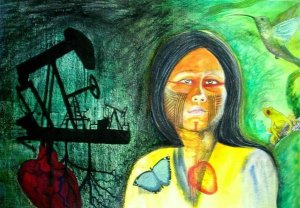
Ecocide by Carlita Shaw
KO: I have been thinking about the absurdity of this age and its delusional mythos a lot lately, Phil. What does it mean to succeed on an increasingly brutal, unequal, unjust and dying world? To attain the hollow grandeur and lucre promised by capitalist mythology? This is an age of stark contradiction where the vaunted and self-insulated “captains of industry” reside within a fragile bubble of a new gilded age. All around us countless species of our biosphere shriek in agony. Ancient forests are felled in a nanosecond. Sprawling coral reefs are bleached to a white, enduring death within days or terribly sullied by damaged oil tankers. And all around us the working class are getting poorer and their population is growing. The rich are getting richer, and fewer. Yet the spectacle continues and grows ever more absurd, more disconnected from reality. And I cannot help think that this is what the ruling class wishes. After all, they have no idea how to fix our collective predicament without dismantling the economic, political and social order that produced and perpetuates it.
When I see the pervasive influence and concurrent numbness induced by the holograms of social media and the surveillance state I am reminded of Plato’s Allegory of the Cave. These projections on the wall, holograms of reality, are ubiquitous. Everyone has a portable cave handy, carrying them in pockets or purses.
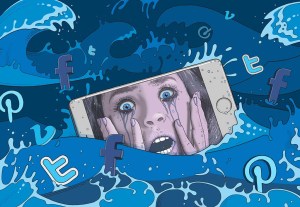
Internet Storm by Tomasz Czerwinski
Screens that alert us to the projected shadows. The things we are told are important. The spectacle. But most of the contents are meaningless images that reinforce depravity, as well as alienation and emptiness. A deceitful mirror that informs us on how we should look, or think, or act. And to never question the order itself. And the insidious sway of this over our consciousness is by design, whether intentional or not, because it emanates from the halls of capital. So then our minds are colonized by the most powerful and moneyed colonizers in all of human history. Yet most of us have difficulty understanding where our agency is curtailed. And this is understandable, because the labyrinth is opaque.
Guy Debord had the prescience to understand this power and how it worked before the age of the internet or social media: “Where the real world changes into simple images, the simple images become real beings and effective motivations of hypnotic behavior.” This is how social media maintains itself and perpetuates a false reality. Social media, through the manipulation of the brains neurochemicals has created a stranglehold on scores of people. Thus, the person who has it withheld may experience anxiety or even panic, a kind of withdrawal.
But this is a sort of mania defines the capitalist order itself. And so this order has a pernicious effect on every one of us because the world is, with few exceptions, under the domination of capitalism and the “imperial” court who benefits from it.
PR: Kenn, a question, then a poetic digression, of which the latter is political, but not in an overt manner.
How does one spend the fleeting hours of this finite life? Is it possible to escape being held in the thrall of internalised colonisation, a psyche-shackling phenomenon that usurps the days of one’s existence? We are confronted by systemic economic control, inherent to the capitalist order, over both the quality and criteria of one’s existence that hijacks the day, renders barren the womb of the earth’s oceans and seas, and scours away by light pollution the stars. An economic order, conceived for the exclusive benefit of a loose-knit, yet unified by their mutual cupidity, clutch of capitalist ghouls. Hyperbole? Do these ghouls not live off of the flesh of the earth and devour the hours of the lives of the powerless multitudes held in servitude to their insatiable greed?
One cannot reclaim what has been lost to time. One cannot conscript coffin dust in the service of eros. Materialism, both economic and philosophical, have wrought a wasteland, of both landscape and mindscape. Yet the breathing moment resounds with birth cries. The archetype of the redeemer god (examples include, Tammuz; Osirus; Dionysus; Orpheus; Jesus Christ; Attis; Mithras; Horus; Krishna; Persephone) exists in the human psyche — we are held, gripped and grappled, undone, and restored by agencies that are not going to be expelled by materialist credo. Archetypal criteria will hold profound influence over the lives of humanity — all as, by reflex, literalism borne of materialist dogma will leave all too many cold and alienated. To wit, the least important — even irrelevant and counterproductive — question is, whether or not the gods are literal figures because, in regard to the human psyche, Mundus Imaginalis is reality.
How does the archetype of the redeemer god relate to the human psyche and the death swoon of the capitalist order?
When the season of a systemic structure that determines the mode of being of individuals languishing within the decaying system has passed, it is crucial that moribund perceptions of oneself and how one regards the world are pruned away. Applying the lexicon of Mundus Imaginalis, one is confronted with the early spring agonies (“April is the cruelest month”) of Dionysus or, as is the case with Persephone, an autumnal descent into the underworld — there, like a brooding seed, it is possible for the psyche to dream a new psychical order — thus novel societal arrangements — into existence. For example, a drunk’s dismally circumscribed by his bondage to the bottle existence can be broken by a rearrangement of the psyche; thereby, his life is broadened and deepened by ceasing an habitual reliance on alcohol previously utilised to mitigate the stressors of the day and torments of past trauma.

Path to Shambhala by Nicholas Roerich (1874-1947)
Widespread consumer addiction is a form of collective, negative enchantment. Sanity insists, the spell must be broken. Yet the God of Reason’s admonitions do not prove propitious in a struggle against addiction because its verities are drowned out by the cultural cacophony of a commodified madhouse, whereby Mundus Imaginalis has taken the form of a 24/7, consciousness devouring, mass and social media-borne phantasmagoria. Conversely, trauma and concomitant neurotic compulsions that haunt the mind and paralyse the eros of modernity can be transformed by artistic engagement. The wound becomes the womb thereby birthing novelty. The grail, at last, at the lips of the languishing, near-death, couch potato king restores the land.
Languishing in middle age, from the reality of his imagination, Dante Alighieri became lost in a dark woods, his path blocked on one side by a hungry she-wolf and on the other by a threatening leopard. But a pagan poet arrives on scene, Virgil, protagonist of the Aeneas, a witness to the folly that was the Trojan War and consequential destruction of Troy. Only by passing through the black, iron-wrought gates of Hell, bearing the admonition, ““Lasciate ogne speranza, voi ch’intrate” (“Abandon Hope All Ye Who Enter Here”) and, later in the epic poem, only after he, led by Virgil, must pass across the loins of Satan in the frozen Ninth Circle would Dante be granted a glimpse, upon entering Purgatory, of Beatrice’s transformative beauty framed in the spheres of Paradise.
The quality of lostness is the redeemer god’s dominion, the baffling terrain on which we are stranded at capitalist eon’s end. Thus I have made a home in being lost.
But the question persists, how does one spend one’s days?
KO: Time is perhaps, as Einstein once averred, an illusion. And yet we experience it. We sense its passing and not just by numbers, but by what we truly sense. With each new wrinkle on the face, each new diminished ability, each child passing through years of development into adult bodies. So we pass the time, so to speak, regardless of whether we are intentionally doing it. But to live mindful of this is the challenge. And I am loath to use that term given the nauseating manner in which it has been twisted in order to justify each new demoralizing and diminishing assault by the lords of Capital on the working class. But this era demands a new kind of mindfulness, one which turns everything on its head.
I remember wandering through the catacombs of Paris several years ago and marveling at the ancient artistry of this underground necropolis. Here was a place built for the dead. A place not to be seen by the masses. Yet now the masses tromp through its’ dusty passages daily, snapping selfies and posting check-ins. Now many modern artists have made graffiti masterpieces in some of the unused tunnels. And so your mention of art and “the wound becomes the womb” made me think of this for some reason. And I think it is the association of art with death, because death, and its constant looming over all who are mortal, is the regisseur of artistic expression.
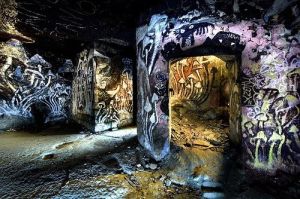
Modern graffiti art in the Catacombs of Paris
The Redemption in this age must come, as it always has, from radical artists, poets, writers, mystics and philosophers, because they are the most radically dangerous to the order itself. Their resistance to conformity, racism, militarism, the commodification of nature, and blind, rapacious consumerism, presents the greatest challenge to a hegemony which cannot expunge the reality of its destructive nature. It can no longer hide the carnage. As Yemen endures carpet bombing and a manufactured famine and Kashmir and Gaza resist an engineered genocide, refugees flee their homelands in Syria, Honduras and Myanmar, as countless species succumb to habitat loss and pollution, and as the Bahamas lie in ruins from climate changed, angry skies and rainforests in the Amazon, Angola and Australia unnaturally burn to ash, we are all witness to the trajectory of unfettered capitalist, militarism, and industrial exploits. Indigenous peoples on every continent face the brunt of this, of course. But we are all indigenous to this besieged earth. We are born of its loam and kin to every breathing species that crawls, slithers, burrows in it or that flies above it.
So at this eon’s end, as you say, I think we are called to bear witness as we traverse its bitter, blood drenched killing fields. But also to tread with care and with arms locked in solidarity with others who have been cast off, devalued by the imaginary calculus of capital. Those on the margins of empire. Those disappeared or assigned annihilation because of the imaginary borders in which they live, or their dearth of societal status or material wealth, or whom they spend their lives with and love, or their caste, gender, skin pigment, religious affiliations or individual peculiarities. And to reignite a reverence and kinship with the myriad of species outside our own. Those that have been commodified and reduced to barcodes.
To be lost with the lost. I think this is our species last, best hope for redemption.
Title artwork for this piece is a colourized version of the Flammarion wood engraving. The artist is unknown but it became popular after it appeared in Camille Flammarion’s book L’atmosphère: météorologie populaire (“The Atmosphere: Popular Meteorology”) in 1888. It is often associated with both the scientific and mystical or mythic quests for wisdom and knowledge.

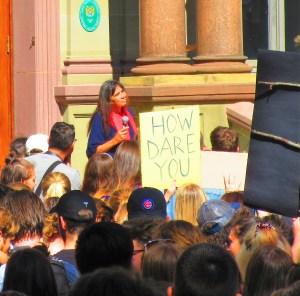 Among the speakers was Darlene Gilbert, a Mi’kmaq grandmother who was arrested for protecting the water from the polluter of Alton Gas. She also courageously confronted Justin Trudeau about his abysmal environmental policies, treatment of First Nations in Canada, and support of pipelines and the cancerous, visible from space, lesion on the face of the planet, the Alberta Tar Sands. Her daughter also spoke with passion about her cultural and sacred heritage of protecting the earth. Every indigenous person I have ever met understands that climate change is real because it is altering, in terrible ways, the ecosystems they revere and depend on.
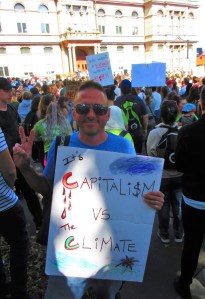 *Note: I will not tolerate cynical or disparaging remarks. I am in no mood to wade into the cesspit of misanthropy and cynicism I see unfolding, especially in social media. I have already analyzed and written tons on this subject. Just search this blog or google it for evidence of that. There is no need to “educate” me or others right now. Be forewarned that they will be deleted, so if you are inclined to do so simply scroll on by.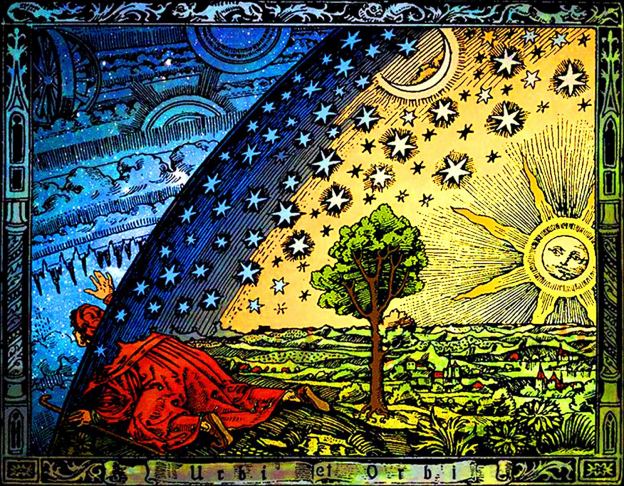
 Kenn Maurice Orfanos (Orphan)