
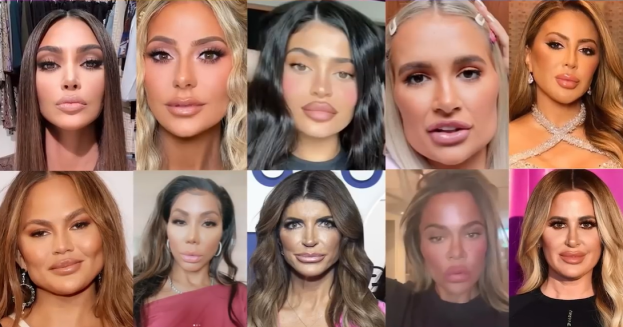
Perhaps you’ve noticed something. The faces of so many celebrities and influencers are beginning to look, well, not human. There has been a noticeable shift in aesthetics in Western society. One that supposedly defies the aging process, but that has ended up being unsettling and rather frightening.
Full disclosure, I have had micro-derm abrasion, botox and other procedures in the past and I love facials and other similar services. Without a doubt, I do care how I look. And there is absolutely nothing wrong with feeling good or enhancing your appearance. In fact, I have great respect for people who become aestheticians.
But this is about the beauty industry under late capitalism. It is an industry that preys upon the insecurities they foster. And their primary target is young girls and women. The saddest example I have seen of this were 15 and 16 year old girls buying “anti-aging” serums at Sephora.
In fact, the language that the beauty industry uses is telling in and of itself. “Age-defying” or “anti-wrinkle.” It is as if these things are medical conditions that must be treated before you die from them. Wars against time that must be fought by expensive procedures that literally alter the contours of your face.
And influencers peddle these ideas with astonishing speed and success. Watching them on the screens we carry around in our pockets, we are transfixed by both the spectacle and the soothing ASMR.
Hollywood also plays an enormous role, as an older female actor is constantly under scrutiny for her “youthfulness.” How many young women in the industry today have faces that appear less human because they fear being “aged out” of acting? Overly filled lips. Foreheads that do not move. Emaciated bodies. None of this is to shame or make fun of them. But to examine the pressure that people, especially young women, endure daily to conform to this specific aesthetic.
The significant medical risks involved in such procedures, from fillers to botox, should not be ignored either. I won’t go into detail about that here, since I would be out of my depth. But there is ample evidence of botched cases, infections and problematic health consequences one can find on a simple internet search.
The wellness movement under capitalism has adopted these tactics too, joining the beauty aesthetic to health and well being. If you are tired or your face is showing the signs of fatigue, it isn’t that soul-sucking, under-waged job you have to go to in order to live on this planet that is at fault. It is your face, literally. Essentially, it is shaming us for still being alive and showing the signs of that aliveness, while ignoring the real factors that cause a person stress.
There is also an underpinning of racialized aesthetics that should be addressed. Whiteness has always been elevated as the pinnacle of beauty in Western society. And it still resonates today. Actor and model Sydney Sweeney recently came under fire for her American Eagle jeans ad. The implication was that while she was selling the clothing product, she was also giving a racist dog whistle about her “superior” genes. And in a subsequent interview, she did not deny these accusations. The point being that there is a persistent standard of beauty in the West that glorifies white youthfulness while denigrating or disappearing those who do not conform to it.
The pursuit of youth and beauty is nothing new. We can see evidence of it throughout human history, and it has taken a wide variety of forms. But late capitalism has warped culture in a way never before seen. It cynically uses our deepest fears against us and promises us fulfillment through technology and spending lots of money. And that technology takes its toll on social interactions and cohesiveness in society.
How often have we looked at a face that does not seem real? That doesn’t emote in a way we can relate to? That doesn’t move? This kind of facial alteration severs the normal social dynamic we rely on for social cohesion, one that has evolved over millions of years.
Regardless of what the beauty industry says, aging is not something we must wage a war against. It is a fact of our existence. While there is absolutely nothing wrong with going to the spa, getting facials or even undergoing treatments or procedures that make us feel better, we should not feel pressured to do so or go into debt because of it. We should try to understand the forces at play that often make us feel unworthy or unattractive and the enormous amount of money being made from reinforcing those insecurities.
Aging isn’t always easy. But there are cultural attitudes that make it unnecessarily harder. In truth, we should be appreciated for how we look at any age. And we should not be mocked or rendered invisible if we do not conform to a largely unobtainable and incredibly exorbitant notion of beauty.
Even as we take care of our skin, we should not feel the need to hide its age by buying expensive concealers, deform it with risky fillers or numb it out of existence through paralytic drugs. Humans can be beautiful at any age, but most especially when they hold on to the very things that make them human to begin with.
Kenn Orfanos, November 2025
 Kenn Maurice Orfanos (Orphan)
I’m not sure your argument is helped by admitting you use anti-ageing treatments on your face.
LikeLike
Who said that I used anti-aging treatments? The microderm abrasion was for acne scars I got as a teenager and the botox was for headaches I got from over use of a muscle in my face. As I said, I do not condemn people caring for their skin or getting treatments that made them feel better.
LikeLiked by 1 person