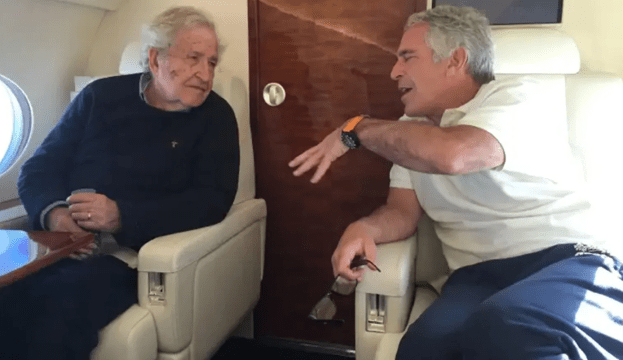
As more and more of the infamous Epstein files become revealed to the public, the subject of Noam Chomsky’s association with the sexual predator cannot be understated. His wife Valeria released a public statement which comes across as tone-deaf apologia for her husband, who is unable to communicate due to a stroke he suffered. Chomsky is 97.
In email exchanges with Epstein, Chomsky’s disdain for the # MeToo movement is apparent. This is where he reduced outrage of the public regarding the credible and substantiated allegations against Epstein as “hysteria that has developed about abuse of women.” He offers sympathy to Epstein for the “horrible way” he was being treated in the press, and then goes on to give him advice on how to deal with the accusations.
Chomsky and his wife weren’t merely guests at Epstein’s dinner parties and salons, they enjoyed many of the perks of being in his orbit, from stays at his lavish properties to rides on his private jet. Chomsky once wrote to Epstein that it was a “fantasy” to visit his notorious Caribbean island.
Apart from Chomsky’s major and important influence on modern leftist thought and his stated opposition to authoritarianism and the cruelty of the powerful, the contradiction with his relationship to Epstein isn’t so much an anomaly as it is a common thread to other troubling positions the linguist/philosopher held. Throughout his life, Chomsky defended other unsavory characters like Pol Pot and Slobodan Milošević, painting them, as with Epstein, as being the real victims in a political and media witch hunt.
In the case of Pol Pot, Chomsky derided the testimonies of refugees who witnessed the genocide carried out by the Khmer Rouge as “unreliable.” And he painted the victims as likely being “enemy collaborators,” blaming them and trivializing the horrors that befell them. For a man who prided himself for analyzing state propaganda, Chomsky seemed to swallow the official line of the Cambodian regime as absolute truth.
He would later backtrack by saying that he never denied the genocide, but blamed American bombing campaigns for radicalizing the Khmer Rouge. He would never apologize for his stance, instead he viewed his early skepticism as being reasonable given the information available. Apparently, the victims testimonies of the genocide, which numbered in the thousands, were not sufficient for him.
Chomsky would once again repeat his genocide denial when it came to the now defunct nation of Yugoslavia. In 1995, at least 8,000 Bosniak men and boys were murdered by the Bosnian Serb army in Srebrenica. In this instance, he used a tactic commonly employed by Zionists, saying that to refer to this atrocity as a genocide “insults the victims of the Holocaust.”
This was astounding given Chomsky’s lifelong condemnation of Zionism. But he would later defend a genocide denialist book by journalist Diana Johnstone, which questioned the scale of Serbian crimes and diminished such evidence as photographs taken of emaciated prisoners at Bosnian Serb concentration camp, saying that they were “probably right” to be labeled as “false” by others.
This stunning dismissal betrayed the importance of photographic evidence in documenting atrocities, from those of American army massacres of Indigenous peoples to those taken of emaciated victims at Auschwitz. In 2015, Chomsky was awarded the Order of Sretenje by then-Serbian President Tomislav Nikolić, an honour which underscores a troublesome pattern of prioritizing the powerful over their victims.
The revelations about Chomsky do not expose any criminal misconduct, but they point to a glaring moral blind spot that has poisoned a segment of the left which rightly exposes the crimes of American and Western imperialism, but ignores those committed by adversaries of the West because they are inconvenient to their narrative. His contributions to leftist thought and analysis should not be dismissed. But the dire influence he has had on a segment of the left which continues to prioritize states over their victims should not be ignored either.
Kenn Maurice Orfanos, February 2026
 Kenn Maurice Orfanos (Orphan)