

Tag Archives: noam-chomsky

Noam Chomsky’s Association with Jeffrey Epstein Reveals a Troubling Pattern of Siding with the Powerful Over their Victims.

As more and more of the infamous Epstein files become revealed to the public, the subject of Noam Chomsky’s association with the sexual predator cannot be understated. His wife Valeria released a public statement which comes across as tone-deaf apologia for her husband, who is unable to communicate due to a stroke he suffered. Chomsky is 97.

In email exchanges with Epstein, Chomsky’s disdain for the # MeToo movement is apparent. This is where he reduced outrage of the public regarding the credible and substantiated allegations against Epstein as “hysteria that has developed about abuse of women.” He offers sympathy to Epstein for the “horrible way” he was being treated in the press, and then goes on to give him advice on how to deal with the accusations.

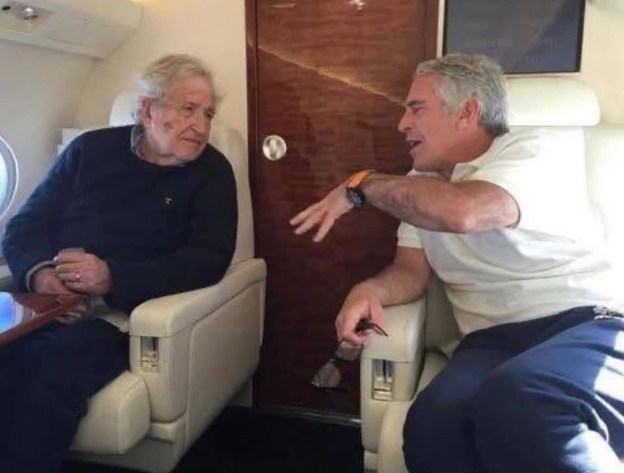
Chomsky and his wife weren’t merely guests at Epstein’s dinner parties and salons, they enjoyed many of the perks of being in his orbit, from stays at his lavish properties to rides on his private jet. Chomsky once wrote to Epstein that it was a “fantasy” to visit his notorious Caribbean island.

Apart from Chomsky’s major and important influence on modern leftist thought and his stated opposition to authoritarianism and the cruelty of the powerful, the contradiction with his relationship to Epstein isn’t so much an anomaly as it is a common thread to other troubling positions the linguist/philosopher held. Throughout his life, Chomsky defended other unsavory characters like Pol Pot and Slobodan Milošević, painting them, as with Epstein, as being the real victims in a political and media witch hunt.

In the case of Pol Pot, Chomsky derided the testimonies of refugees who witnessed the genocide carried out by the Khmer Rouge as “unreliable.” And he painted the victims as likely being “enemy collaborators,” blaming them and trivializing the horrors that befell them. For a man who prided himself for analyzing state propaganda, Chomsky seemed to swallow the official line of the Cambodian regime as absolute truth.

He would later backtrack by saying that he never denied the genocide, but blamed American bombing campaigns for radicalizing the Khmer Rouge. He would never apologize for his stance, instead he viewed his early skepticism as being reasonable given the information available. Apparently, the victims testimonies of the genocide, which numbered in the thousands, were not sufficient for him.

Chomsky would once again repeat his genocide denial when it came to the now defunct nation of Yugoslavia. In 1995, at least 8,000 Bosniak men and boys were murdered by the Bosnian Serb army in Srebrenica. In this instance, he used a tactic commonly employed by Zionists, saying that to refer to this atrocity as a genocide “insults the victims of the Holocaust.”

This was astounding given Chomsky’s lifelong condemnation of Zionism. But he would later defend a genocide denialist book by journalist Diana Johnstone, which questioned the scale of Serbian crimes and diminished such evidence as photographs taken of emaciated prisoners at Bosnian Serb concentration camp, saying that they were “probably right” to be labeled as “false” by others.

This stunning dismissal betrayed the importance of photographic evidence in documenting atrocities, from those of American army massacres of Indigenous peoples to those taken of emaciated victims at Auschwitz. In 2015, Chomsky was awarded the Order of Sretenje by then-Serbian President Tomislav Nikolić, an honour which underscores a troublesome pattern of prioritizing the powerful over their victims.

The revelations about Chomsky do not expose any criminal misconduct, but they point to a glaring moral blind spot that has poisoned a segment of the left which rightly exposes the crimes of American and Western imperialism, but ignores those committed by adversaries of the West because they are inconvenient to their narrative. His contributions to leftist thought and analysis should not be dismissed. But the dire influence he has had on a segment of the left which continues to prioritize states over their victims should not be ignored either.

Kenn Maurice Orfanos, February 2026
On Noam Chomsky and the Powerful

There seems to be some handwringing around the news that Noam Chomsky associated with Jeffrey Epstein. Some have condemned it, while others have rationalized that there is no evidence Chomsky did anything inappropriate. But there is a way to understand this that helps to separate a person and their choices from their work in furthering critical thought and informed dissent.

Chomsky was photographed on the dead sexual predator’s plane and attended dinner parties at Epstein’s Manhattan townhouse. Powerful men were at these dinners. Prince Andrew being one. At least one of those was with Israel’s former prime minister, Ehud Barak.

In fact, Epstein apparently arranged several meetings with Chomsky and Barak. It is worth noting that Barak is named by one of his victims, the late Virginia Guiffre, who said the prime minister raped, choked and beat her. She went into far more graphic and horrific detail that I will not get into here.

To be sure, our society has a tendency to jump to snap judgments. Guilt is ascribed to anyone who may appear in a photograph or video without context or a nuanced understanding of the complexity of human interactions and motivations.

Salacious gossip all too often replaces critical thinking, the latter viewed with contempt by many in the media. Merely talking to the “wrong person” will get you pilloried in some camps. And Chomsky spoke with a lot of shady and loathsome figures, from Steve Bannon to Alan Dershowitz to the aforementioned Ehud Barak.

There is also a poor understanding of how age and health comes into all this. After all, Chomsky is very old. And he did suffer a debilitating stroke during these years.

But this is not some random association. It is about directly benefitting from the very power you claim to oppose. Epstein reportedly assisted Chomsky with some financial matters regarding his late wife’s estate.

Many academics and scholars fall into this trap because, like it or not, we live in capitalism. Dealing with its adherents and institutions is inevitable. And such dealings are often the Faustian bargain most make to secure the needed funding for their research and work.

Chomsky reportedly knew about some of Epstein’s crimes, but said he had a “clean slate” after serving some time for an offense. No one can say if he knew more than what was reported at the time. Anything else is speculation. And as someone who believes in restorative justice, I can relate to this.

But this isn’t about that. Epstein wasn’t just some ordinary person. His crimes were far greater than any “justice” he may have received at the time. Epstein procured girls and women for wealthy and powerful men to abuse and exploit. He was unrepentant about all of it. And Chomsky didn’t show any care or concern for his victims.

Chomsky has been put up on a pedestal by many on the left. And I confess that I have had a great respect for the man throughout my life. I met him once at a lecture many years ago and I read his books cover to cover. They changed my worldview regarding capitalism, propaganda, and the machinations of American empire. And I am grateful for that education.

The importance of his work and how it can be used to understand and confront imperialism shouldn’t be jettisoned. Only a fool would do that. But he also had a troubled relationship to power. The tragedy is that his connections to power may betray the informed analysis and dissent he is credited for to many people seeking direction in this dark world we live in.

So, how should we proceed if we care about the very subjects Chomsky is famous for?

While we can and should still learn from the many things Chomsky has done throughout his long life, we should have a greater sense of what it means in real terms. Liberation from oppressive structures, including patriarchal and misogynistic ones, requires solidarity with its victims and survivors. So, I think if there is any solidarity we can assert at this time, it should be unequivocally with the women who suffered, often as children, at the hands of the powerful men he associated with.

Kenn Orfanos, December 2025