Author Archives: Kenn Maurice Orfanos (Orphan)

Unknown's avatar

About Kenn Maurice Orfanos (Orphan)

Kenn Orphan is a social worker, artist, and human and environmental rights advocate.

It is Too Late to Pretend

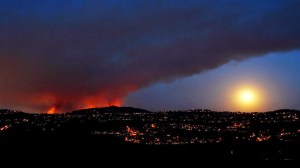
san-diego-brush-fire-pg-047All across California records were shattered today. It is hot, very hot, too hot…and it is only May. Santa Ana winds, hot dry air from the desert, have always come in October and November, not in May. Yet they swept through California this week fueling wildfires that are still raging. And it isn’t just here. Siberia has experienced massive wildfires this winter and spring. New Jersey too. Australia’s summer temperatures soared so high this year that they had to assign it an entirely new color on weather charts. Rain, flooding and wild weather has battered the UK and Ireland and the Mid and Southwest, as well as Pakistan and Afghanistan this spring. And drought is drying up the Amazon, the Middle-east, Southeast Asia and the American west.

There is no debate among scientists. Climate change is undeniable.

Even the record cold winter in the Northeast of the US is a testament to this, because warming has shifted the polar vortex. Now the North Pole is warming while its cold air is displaced, melting further the dwindling ice of the Arctic Sea. And this week we learned about the unstoppable collapse of the West Antarctic Ice Sheet which will eventually inundate coastal areas and cities the world over.

Not only is climate change happening, it is, in the view of the vast majority of climate scientists, human caused. Yes, the climate has changed in the past, long before humans entered the scene. Yes, climate is always changing. But there is a certain cognitive dissonance which continues to reign in circles that insist humans cannot possibly have such an impact on the planet, that these scientists are in it for the money, or that climate change is actually a good thing.

We know with certainty humans can effect major natural cycles and devastate ecosystems. One glance at the power of nuclear bombs or the massive deforestation taking place throughout the world confirms this easily. Humans have been able to literally alter nature to make certain plants, that were once toxic, edible, and to domesticate animals that were once hostile. So it should not be a stretch of the imagination to see how industrialized society, built on fossil fuels, is having a major detrimental impact on the climate.

The influence of the fossil fuel industry is also easy to track. Oil money fuels government intransigence and stokes conflicts the world over. The most profitable industry ever in human history is driven by greed. So the notion that climate scientists are in it for money is ludicrous and absurd. Arguably, they would do far better financially if they sold out to these industries like a handfull have done.

The world’s warming oceans are acidifying rapidly causing fish stocks and coral reefs to collapse. Variations of heat and cold extremes are making agriculture that much more challenging and potentially fueling several conflicts raging around the world. Storms now imperil millions of people on the planet due to their accelerating intensity. So no, climate change is not a good thing.

It is too late to pretend. It is too late to engage in “debates” with people who have their heads firmly buried in the sand. There is no use arguing about a tsunami with someone who stubbornly insists on remaining on a flooding beach. We need to gather up those around us who see what is happening and want to take action, and head to higher ground. With any luck we might be able to save something, while we still have time.

Kenn Orphan  2014

(Photo is of fires in San Marcos, San Diego and is courtesy of Luis Sinco, Los Angeles Times)

Our Very Own Flesh and Blood

kids-swim-trashThis photo is of two young boys swimming in the horribly polluted waters of the Yamuna River in New Delhi, India, by photographer Manan Vastsyayana. India now boasts having the world’s most million and billionaires.  Its economic model is highly praised among the vultures of Wall Street and political vampires in Washington alike. Essentially, it is beloved for its  “free market economy” neoliberalism and “friendliness” to corporations.  Its new Prime Minister, Narendra Modi, has vowed to continue these policies, much to the satisfaction of the World Bank, IMF and Wall Street.  All of this is occurring in a country that has one of the world’s largest gaps between the extremely wealthy and the extremely impoverished; and where the ecosystem is being systematically decimated by industry that has little to no regulation.

But this is not an Indian problem. This scene is repeated the world over, from Jakarta to Manilla to the Dominican Republic and even to the forgotten, abandoned and economic “sacrifice zones” in the US. It is a picture of institutionalized, systemic oppression and exploitation of the world’s most vulnerable by the world’s most powerful; and its scope is growing. It is neoliberalism and globalization at its most base.

So when we see photos like this of children swimming in a plastic soup in Manilla or scavenging for treasures in mountains of industrial and electronic waste in Ghana we should not avert our eyes. Instead it should serve as a reminder to us in the so-called “developed world” of the ramifications of our insatiable, destructive consumption, and the vulturous economic policies that allow for it. It should stand as a rebuke of cupidity and should alarm us that what we are doing to the planet and all of its inhabitants as a whole is a crime of epic proportions tantamount to genocide. And it should help us to see these children not as someone else’s responsibility, but as our very own flesh and blood.

Kenn Orphan  2014

Simple, Quiet, Steadfast Resolution

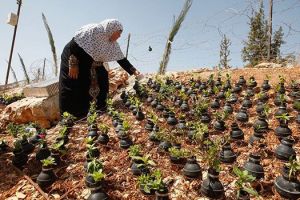
Palestinian womanThere are acts of quiet expression and beauty that transcend the stale or reactionary rhetoric that accompany conflict and oppression, and they often go unnoticed. This is one of them. Residents from the besieged Palestinian village of Bilin have transformed a tool of violence into a message of remembrance and a tribute to the universal struggle for human rights. They have planted flowers in spent tear gas canisters.

It is a memorial to Bassem Abu Rahmeh, an activist who was killed at a demonstration in 2009 when a tear gas grenade hit him in the chest. Tragedy followed this family. Bassem’s sister Jawaher was killed nearly two years later from inhaling Israelis tear gas at another demonstration against the apartheid wall. A wall that has carved up Palestinian lands in the occupied West Bank, separated farmers from their fields and orchards, demolished homes, and divided families.

This garden is a silent memorial to their non-violent stand against an unjust system. It is a testament to the fortitude of the human spirit in a tide of seemingly unending brutality. It represents the countless Israelis and Palestinians who are united in their commitment to justice. It is, as one of the creators of the garden expressed, to show that “life can spring from death.” And it should encourage us all to take back the humanity that the brute and the oppressor have stolen; in simple, quiet, steadfast resolution.

Kenn Orphan  2014

(AP Photo/Majdi Mohammed)

“Remember me to the negroes…”

Domestic Slave with Planters Family, Virginia ca 1859-64This past year I had the pleasure of traveling through the rolling and verdant hills of Tennessee; and while I was there I visited one of the many plantations that dot the American South.  Noble magnolia trees encapsulated the grand brick and white columned building.  Statues and fountains festooned its grounds.  It was a vision of pastoral beauty and deep traditions.

In touring the inside of the main house our guide regaled us with stories of the old south and of its enduring legacy. Period furniture laced the halls and reception rooms of the main floor and portrait paintings of the white family who originally owned and ran this plantation were carefully hung above each of the many fireplaces.

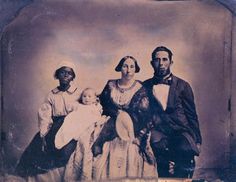
Then our guide, a polite white woman with a genteel, southern accent, took us to the back of the house. There, in a small room off the kitchen, were black and white photographs of the family and their slaves.  In a fashion typical of the time, there was the mistress of the house sitting piously and upright, with hands folded neatly on her lap.  Beside her stood her husband, handsome, stoic and dressed in Confederate finery.  In the foreground sat two white children, and in the back, an old, black lady in a sullen grey and white dress stood holding a white infant, presumably the child of the master and mistress of the plantation.   It was her face I will never forget.

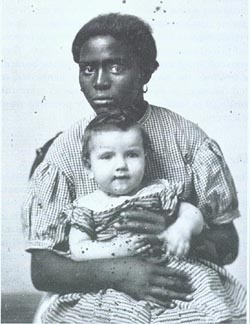
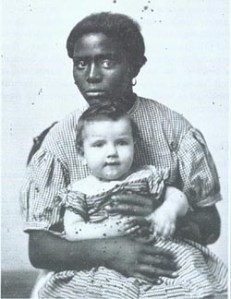
Hayward familys slave Louisa holds master's baby (1858). Source Missouri History Museum, St. LouisShe stood there with a face that was carved from sorrow and hopeless resignation.  I could not help but wonder if she herself was forced to give up her own children.  In her eyes all of the horrors of the African slave trade were revealed.  The beatings, the rapes, the dehumanization, the murders and the abject violence visited upon millions of people, within an economic system of unprecedented exploitation spanning 400 years, stared out at me from that portrait of a land owning, respected southern family.

But our guide did not seem interested in this part of the story.  She gave some begrudging attention to my questions about this woman and the other slaves who lived out their lives being treated as property and livestock.  At one point, perhaps as a nod to my inquiries, she told of us of a letter the master sent to his wife when he was off fighting in the war.  I sat there and listened to her incredulously as she said that he had asked his wife to “remember me to the negroes.”  She explained, with pride, that this demonstrated that he cared about their slaves, implying they had a good life there in bondage and forced servitude. I thought, could someone in this day and age seriously have such an utterly sanitized and romanticized vision of this horrific past?
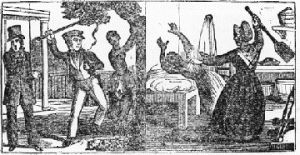
Image depicting slave owners beating their slaves. Source African American History ArchiveShe went on to tell us of how the plantation is currently rented out for weddings and other elegant affairs, presumably without the benefit of forced labor.  I was reminded of other halls of cruelty, exploitation and murder, of the concentration camps in Germany or the internment camps created for Japanese citizens during the second World War.  Would these places be suitable for well heeled events too?

Surrounded by the opulence of European art and architecture, under the shade of giant magnolia trees, I left there feeling bereft of my humanity.

To be fair, not all plantations in the south paint such rosy and romanticized pictures of slavery.  In Florida, I visited just such a plantation.  There among the ubiquitous Spanish moss laden trees, far from the main house, stood rows of slave quarters.  They had not been restored, but this was for a reason. This plantation did not wish to portray slavery from the glossy and overtly racist Margaret Mitchell point of view.  Here the slave quarters stood starkly as sentries, guarding the sacred history of the voiceless slave.  The main house was empty of furniture.  This was appropriate.  No glory or opulence could shield its dark history of pain.  The gift store, unlike the one in the Tennessee plantation which was filled with local jams and jellies, was filled with books about slavery, many written by former slaves.
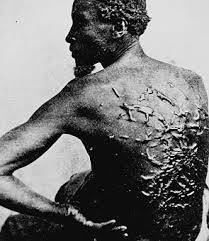
Photograph of a slave with scars from being whippedThis is the history that needs to be told.  It is a history that demands that these plantations be treated as they should, as vestiges to horror and shame.  Without emphasis on this hideous brutality the south, and the rest of the nation for that matter, will continue to churn out a persistent racism of the Paula Deen variety.  A racism that underpins institutional persecution and justifies the ongoing state violence being perpetrated on black and brown bodies.  A racism lost in the fantasy of the happy slave and the honorable slave owner.  None such kind ever truly existed except in the minds of the powerful.   These plantations should be reviled for the atrocities they housed, not revered in a romanticized mythology.  They should be visited with sorrow and solemn remembrance, not with novel, fleeting interest.  The ugly and persistent maw of racism deserves this kind of attention and justice.

And the haunting eyes of that nameless slave in a portrait in a plantation in Tennessee should see nothing less.


Kenn Orphan  2013