
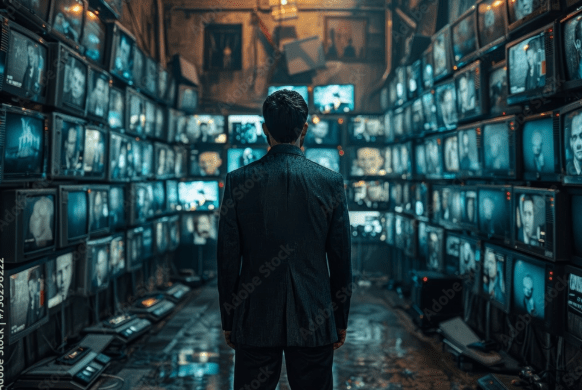
Whether we like it or not, screens, social media and AI are facets of modern life. Our society has become so integrated with these mediums and processes that it simply cannot exist without them. We depend upon them for everything from casual communications to communiqués, shopping transactions to banking, powering our appliances to the entire energy infrastructure grid.
In many ways, these mediums have enhanced our lives and helped us to stay informed or in touch with people from our past or whom we may have never known. It has helped artists, musicians, writers and content creators launch careers outside of the traditional legacy formats. It has also been an integral part of raising awareness and generating support and solidarity with important social causes or movements, whether it be Black Lives Matter or the genocide in Gaza.
But the dark side of this phenomenon has been the erosion of our critical thinking capacity and the skillsets required for civic engagement. The result is often a dangerous disconnect from reality. And this has been by design. Our brains can only process so much. They have evolved to tackle problems one at a time. To focus on one thing. But we have been conditioned to accept a kind of manic engagement with life.
Tech companies understand this all too well. They have meticulously curated the dopamine reward system to keep us coming back. The use of the colour red, for instance, is no mistake. It creates stress in our brains. A stress that must be relieved by “clicking” on an icon to see what is being “missed.” It is essentially a means of social control via the manipulation of neurochemicals and reward pathways.
And it may have very serious ramifications for our mental health. In fact, there is a new term that is being used: AI Psychosis. Tech companies have been aggressively marketing their AI chatbot services. But by making so many individuals dependent upon a pseudo-assistant/companion, the danger of psychological and cognitive disconnect from reality increases exponentially. For many who struggle with their mental health, the AI “therapist” may seem like a lifeline. But going to a chatbot, one devoid of human empathy, morality or ethics, can lead to disaster.
In addition to this, there is ample evidence of tech companies cooperating, working in tandem with, and even developing technology that increases the surveillance of civilians and independent organizations. That these companies already censor so much online content from those who confront the institutions of capitalism or the continuing colonial and imperialistic projects is troubling enough. But when they work hand in hand with authoritarian governments or despotic regimes to suppress any and all dissent, we are at risk of losing any semblance of democratic norms that we have left to us.
What is even more concerning is how screens have altered the current generation. Children are being taught to be bored with life absent constant stimulation from the screens they carry around in their pockets. Don’t believe me? Ask most teachers these days who have been sounding the alarm for several years now. They cannot get through a lesson plan or assignment without encountering huge amounts of indifference or outright hostility.
And what’s worse, is that the ubiquitous and insidious nature of screens is steadily siphoning off the moral imagination and empathy that are required for healthy human development, social relationships and societal cohesion. How will these children develop healthy relationship patterns and interactions with other children and adults? How will they be able to cope with a world that is nearing the collapse of climate stability? How will they be able to problem solve and address the coming shortages and scarcity? How will they be able to confront despotic political figures and groups who use such crises to scapegoat or enact authoritarian policies?
There is also a huge component of this phenomenon that isn’t being adequately addressed. The tech companies responsible for the denuding of the public mind are also raping the natural world. AI requires extraordinary amounts of resources. Every day, individual data centres consume millions of gallons of water for cooling. Just one data centre has the capacity to use as much water as a small town. Despite efforts to conceal their ecologically catastrophic practices, Amazon dwarfs its competitors, Google and Microsoft, in its consumption of water. In 2021 alone, Amazon used as much water as the city of San Francisco to operate its heat generating AI farms.
Without going so far as advocating for Luddism, there are compelling reasons to reflect on the grave impact of AI in an era of rising fascist authoritarianism, extraordinary economic inequity, and a biosphere that is imperiled by the predations of late capitalist exploitation. Tech billionaires and their corporate behemoths do not believe in democracy or even in humanity or the preservation of the biosphere. This can be seen clearly by delving into the unhinged far-right apocalyptic and conspiratorial thoughts of figures like Peter Theil. Mark Zuckerberg would prefer you jettison your human friends for AI simulations. Jeff Bezos would like you to shop for endless items on your phone without regard for worker’s labour rights or the impact on the planet.
But there are limits to these trends that neither billionaires or their corporate shareholders can control. Despite enormous efforts to control the narrative surrounding Israel’s genocide in Gaza, most see through the lies. Despite the constant flow of pixelated slop, AI generated reels and tone-deaf ads on our newsfeeds, many are starting to connect the dots of their own alienation and atomization to the reality of living in a capitalist dystopia that is growing ever more tedious and out of touch with most lived realities.
There is also evidence that many people are simply letting the whole idea of “casual posting” go. After all, looking at a photo of someone’s meal next to the image of a starving child in Gaza has contributed to the moral outrage and growing dissatisfaction with banality and indifference to the very dire and urgent ethical questions of our age. Seeing celebrities fly off in private jets or sport expensive clothing while most people are struggling in this economy just doesn’t have the same impact it once did.
Screens dominate our lives. This is a truth of living in the early decades of the 21st century. And it should not surprise us that in this stage of brutal and ruthless late capitalism, the wealthy and powerful are continually trying to harness them for profit and social control. But understanding this dynamic is the first step at breaking the spell of the screen and unraveling its digital noose around the neck of humanity.
Kenn Orfanos, November 2025
 Kenn Maurice Orfanos (Orphan)